Across Continents

Ken's Blog

Beyond Batumi

April 22nd, 2010

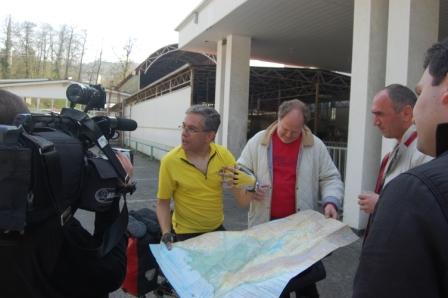
The plan was simple enough. Head north up the coast to Kobuleti, then inland towards the town of Ozurgeti, the hub of Guria region, meeting up with Eto around four in the afternoon. We’d not had chance to agree exactly we’d rendezvous, but I was confident that if I cycled around the place long enough, she’d find me. Thought I’d be easy to spot, couldn’t be that many Englishmen on bikes looking lost. Worked quite well. Actually, when I arrived in the centre I spotted a TV cameraman, and made straight for him. Struck me as a good idea, he even filmed me for a while but then disappeared. Never worked out who he was, and nobody else seemed to know either.
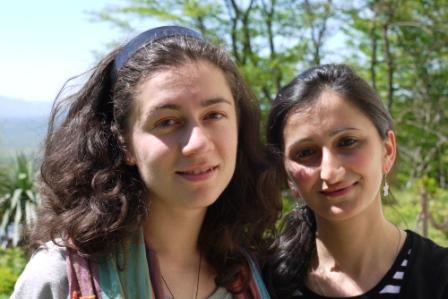
Eto and Nazi

Eto – on the left in the photograph – explained they’d been a slight change of plan, I’d be staying twenty miles further on in the small town of Chakhatauri, close to where she lived. Her father George had brought the car so there was no need to cycle. Unfortunately, three people, Emma, all my panniers and a Lada wasn’t going to work, so we compromised – they’d take the luggage and I’d cycle there.

But, by now five in the evening, it was first time for dinner and a new dish – Khinkali – described by Georgians as a meal in itself because it contains meat and potatoes in a pasta parcel. Just like the Khachapuri Merab had introduced me to back in Batumi, there’s an art to eating this. You must make sure the juice inside the parcel does not spill out, gingerly biting a small nick and drinking the contents. Sounds simple enough. Took three attempts to get right.

The ride to Chakhatauri was swift, Eto and her father meeting me every few kilometres, and the scenery quite beautiful. A brief climb up from Ozurgeti, then a fast, winding descent onto a wide, flat river flood plain, bounded by steep wooded mountainsides and snow covered peaks on the southern side, the Lesser Caucasus, the sun setting behind me.
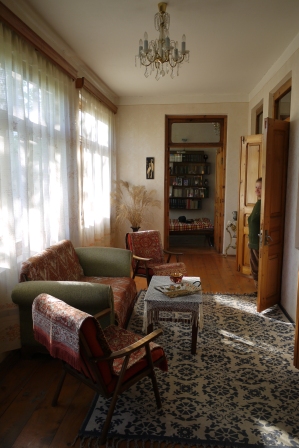
Homestay

It had been an intriguing day, an unexpected but enjoyable ending, but it wasn’t quite over. Eto had arranged for me to stay in the village with Luara, more of a home stay than a bed and breakfast. Greeted with tea and cake, one last thing to do before retiring, an interview with local journalist Kate, Eto acting as interpreter and George offering a few questions of his own. Intrigued to know what would happen if I fell in love along the way. Thought my answer very diplomatic.

Share

A taste of Batumi

April 22nd, 2010

The Black Sea resort of Batumi had been a favourite of the Russian Politburo, and Stalin, himself a son of Georgia. Probably explained the apparent lack of hideous concrete monstrosities often associated with the former Soviet Union. But this is a city undergoing a lot of change, seeking to transform itself into a modern holiday destination. The Sheraton Hotel opens shortly, with other international names to follow. Modern casinos have appeared, drawing in gamblers largely from Turkey. Las Vegas of the Caucasus? No, the city has substance, a pleasing architecture, the new largely blending with the old.

But I was much more interested in getting a sense of what it was to be Georgian. Dinner the previous evening provided a little insight, host Kurt acting as the Tamadan – toastmaster – a role he seemed very accomplished in. There are at least seven toasts, and can be as many as twenty, so it’d seemed wise to opt for Georgian wine rather than vodka. My recollections are a little blurred, but peace, friendship, family are very important. And the welcome I’d had, from the moment I crossed the border, seemed to confirm this.

Khachapuri

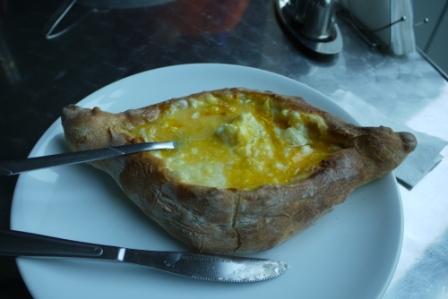
They’d been a good deal of Georgian dishes to sample over dinner, but Merab, my host once more the following day, was insistent we try the local form of khachaprui, a bread shaped like a boat and filled with eggs, cheese and butter. The trick is to mix the contents thoroughly so they ressemble scrambled eggs, then tear off pieces of bread and eat the whole lot with your hands. Some scope for improvement on my part. Calorific content? Thousands apparently.

I’d enjoyed Batumi, there’d been a fantastic, almost humbling, welcome. But I needed to head north-east into the Guria region, making my way towards the route through the mountains that divide east and west Georgia.

[The author is indebted to the warmth and generosity of those who have made him so welcome at the border, and in Batumi, especially Merab from Batumi Business School, Shota Rustaveli State University, Kurt, and Vadja from the city’s tourism organisation]

Share

Europe or Asia?

April 22nd, 2010

I’d thought it a simple question, one I’d scribbled in my notebook back in eastern Turkey. Republic of Georgia – Europe or Asia? After all, back in Istanbul, cross the Bosporus from the west and you’re in Asia Minor, no doubt about that. But Georgia? Joining my hosts Merab, Kurt and Vadja for dinner in Batumi, it was abundantly clear that Georgians firmly consider themselves to be Europeans.

I thought their reasoning pretty compelling. For one thing, they asserted, they didn’t look like their Asian neighbours, much more like Europeans. And, like much of Europe, they were a predominantly Christian country, the Georgian Orthodox Church the dominant religion. And what I’d seen so far of western Georgia reminded me quite a bit of former Eastern Bloc countries like Serbia and Bulgaria, albeit with an unexpectedly different, sub-tropical, climate. Quite a few palm trees amongst those I’d expect of a more temperate region, finding oranges, kiwis, even tea, growing along the Black Sea coast.

Persuasive cultural arguments for being European, but there was also a political dimension, Georgia keen to join the European Union, aligning itself with the west. As for the geographical dimension, do you draw the line at the Great Caucasus Range that borders the country to the north, or the Lesser Caucasus to the south? Whatever the answer is, I’d don’t remember the continents being so confusing at school. Happy days.

Share

“Be strong”

April 22nd, 2010

The short ride north of the border crossing, towards the Black Sea resort of Batumi, provided a sharp introduction to cycling in Georgia – a few Turkish lorries to contend with still, but the real challenge lay in avoiding the cattle that wandered, quite oblivious to traffic, across the road. That and the double overtaking, which left you wondering which side of the road vehicles were meant to drive on. And if you needed another reason not to ride in the dark, that’d be the craters – potholes big enough to wreak havoc to cars.

Catching up with hosts Merab and Kurt on the outskirts of the city, the plan was then to follow their 4×4 to a small hotel they’d generously arranged for me. There were a few roundabouts to contend with, and many of the roads had been dug up whilst an entirely new mains water system was installed. I’d no real idea about the Georgian highway code, but, it seemed, neither did anyone else. I just stuck as close to Merab and Kurt’s vehicle as I could. Explaining my bemusement to Kurt, a German spending a couple of years in Batumi working with local organisations to help develop tourism, he offered some simple advice for cycling in the country. “Be strong“. And he meant it.

Share

Welcome to Georgia

April 22nd, 2010

Interview at the border

It did seem a bit strange at the time, a cursory look at my passport, entry stamp, then beckoned by a border guard past all the cars being meticulously searched. It was as if I was expected. Which, it turned out later, I was.

Emerged from customs control to be greeted with Georgian wine, chocolates, local TV and radio. Bit of a surprise, but the interviews – in English I hasten to add – seemed to go well, especially given Emma and I had just sprinted over ten miles to reach the border on time, unexpectedly delayed by a puncture, the second in two days. But that was Turkey, and this was Georgia, and we were already captivated, intrigued by what lay ahead.

[Photograph courtesy of Merab Diasamidze, Batumi Business School, Republic of Georgia]

Share

Staying sane

April 17th, 2010

Staying sane from Ken Roberts on Vimeo.

Ever wondered how Ken amuses himself during those lonely nights on the road? Probably not. But find out anyway by watching the video.

Share

Back on form

April 17th, 2010

Back on form from Ken Roberts on Vimeo.

Back on form, catch up with Ken at the end of a ninety mile day as he prepares to cross the border into the Republic of Georgia.

Share

Out of character

April 16th, 2010

I’ve already encountered a few derivatives of the Russian Cyrillic alphabet, mostly in simplified form – in Serbia, and Bulgaria for example. And even Turkish has a few more characters than our own – some with distinct new sounds, others just extending the duration of vowels.

Being able to grasp what’s written is hugely important, for two main reasons – menus and maps. The first is pretty self-evident, but the second? Problem is my maps have mostly been transliterated into the familiar Roman alphabet, helpful if I want to attempt to pronounce places, but often hopeless if you want to relate them to road signs, or show to local people when seeking directions.

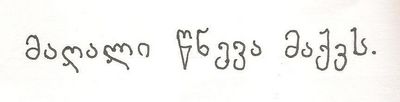
Georgian text

And then there’s Georgian. Quite unique. Looks beautiful, the characters perhaps resembling the grapes found in this wine producing country, but wholly incomprehensible to me. And nothing like what’s on my map, which in this instance is fine, as the expression is something I found in the medical section of my phrase book. Still, doubt it’s as challenging as Chinese…

[And the Georgian phrase? Answers please via my website Contacts page. I’m indebted to Pat at www.survivalgeorgian.com for her help, and a phrase book. Incidentally, entries are still being accepted for the ’Name all the ’Stans’ competition – if it helps, Wazakstan and Moronastan are not recognised nation states (you know who you are), and Yogistan is a fictitious country in the W E Bowman classic tale ’The Ascent of Rum Doodle’]

Share

Back on the road

April 11th, 2010

ac globe - refreshed

Spring. It was good to be back on the road, driving hard along the old Silk Road from Trabzon into Georgia and the Caucasus. No sign of the camels, but lots of Turkish lorries so I kept my eye out for large road kill. Emma and I felt refreshed, the same, we thought, that could be said of our website www.acrosscontinents.org.

Lots of fresh, new content. More videos – with the obligatory shades and mug of tea of course, radio interviews, photos, even a map of my intended route through the Caucasus and the ’Stans. And more to come – Bishkek beckons!

If you’ve not already done so, you can sign up for for automatic blog updates, delivered straight to your e-mail account – click on blog, enter your e-mail address and press ’Subscribe’ – simple. Or join me on Facebook – link on my home page – lots of fresh content there as well. And to find out more about the UK charity, The Outward Bound Trust, I’m raising funds for, either follow the links on my own site, or just click here.

Share

Reflections on Turkey

April 10th, 2010

I might have tired of Istanbul, but not of Turkey and its people. Waiting at the city’s airport for my flight east, my rudimentary Turkish still a bit rusty, an elderly chap, overhearing my efforts at ordering a coffee, helpfully explained that ’thank-you’ was in fact tesekkur ederim (pronounced teshekoor ederim), not merci. I thanked him, properly this time. My plane delayed into Istanbul by bad weather, it was late when I eventually reached my hotel in Trabzon. I was greeted at reception by Sena. She’d remembered me from my earlier stay with my Dad. This was much more like it.

The journey back east had given me plenty of opportunity to reflect on Turkey, and what it was to be Turkish. A strong national identity for a start. The military given equal prominence on television with the politicians. You sensed political satire was still in its infancy, and criticism of Ataturk, founding father of the modern Turkish nation, would be ill-advised. YouTube had apparently hosted a few offending clips and, despite their prompt removal, a court order blocked access to the entire site for a couple of weeks.

Authoritarian undertones? The male predilection for dark clothes certainly adds a Kafkaesque feel, but no, just different boundaries to our own, and certainly not oppressive. In fact the military would probably argue, with some justification, that they have only ever sought to protect the constitution from wayward governments attempting to undermine or erode its tenets.

But things are changing, the balance of power gently shifting towards the democratically elected administration, as tolerance by the Armed Forces of the recent arrests of senior military officers for their alleged part in an suspected coup plot would seem to demonstrate. Either way, a strong Turkey is no bad thing, providing a buffer between Europe and more turbulent nations further east. But I doubted if much of this ever had much of an impact on the lives of ordinary people. It just flickered by in the news bulletins.

Fact is I’d been made very welcome, from the moment I’d stopped to get my bearings in Edirne, my first day in Turkey. Back then, Nadir and Beckant had approached me, keen to show me their home city. They’d been Tugba in Istanbul, Zehra and her friends along the Black Sea coast, Yaren, Ali and Sena in Trabzon. And so many people in the villages who’d so often dragged me off the road, plying me with sweet, warm Turkish tea. Couldn’t ask for more. But now it was time to see what Georgia had to offer.

Share
Terms & Conditions of Use | Copyright © 2009-2026 Ken Roberts