Across Continents

Ken's Blog

Little black book

May 31st, 2010

I’d had an e-mail from an old friend in Scotland. How did I find all these people I’d met or stayed with? Surely my little black book wasn’t that extensive? No, I explained. Some arose from chance meetings on the road. Like Knut, a German now living in Tbilisi, Georgia. Our paths had crossed back in Serbia, we’d kept in touch. He’d helped with many of the introductions in the western Caucasus. Others are fellow travellers, offering their couch to those on the road. A chance visit to a petrol station in Belgrade led to dinner in the suburbs. Many other examples.

An element of luck? Possibly. But a good deal of planning. What’s the road ahead like, my probable rate of progress? When will I arrive? The art of the possible. Back in the Royal Geographical Society in London I’d sat down with Shane Winser to discuss my expedition. Over the years she’s seen what’s worked. And what hasn’t. Outlining my plans, I expected questions on routes, equipment or training. But no, how was I to manage all the information I’d need to assemble to succeed? Weather predictions, visa regulations, funds, logistics and a good deal more. Good point.

Quite a bit was done before I’d set off, but never as much as I’d liked. Problem is that if you wait until you’re ready, you’ll never leave. Especially when travelling for four years. And vital local knowledge is difficult to come by until you’re there on the ground. So, like arranging to meet or stay with people, much is done on the road. A never ending game, one that won’t finish until I make it back to my humble cottage. The World Wide Web is a huge help, my small netbook an indispensable tool. Almost. Over-reliance on technology can be risky. For example, no internet in a large swathe of western China. Problem? Not if you know about it. Just need to plan around it.

Share

Made in China

May 30th, 2010

Alexander

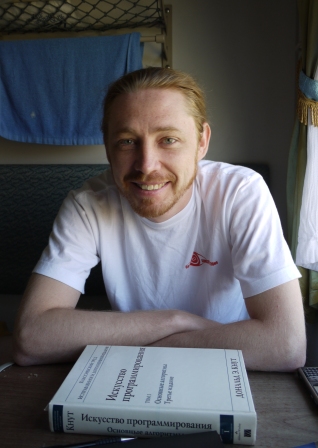
I’d joined Alexander for breakfast in the restaurant car. Borsh – Russian cabbage soup – and tea. We were sharing a sleeper cabin – a coupee – for the twenty four hour train journey from Atyrau to Kyzylorda. Very smart I suggested, air conditioned carriages, towels and bedding in pristine plastic wrappers, much better than the ageing sleepers back in England. Made in China he explained.

With each of us having just a smattering of our respective languages – Russian in his case – Alexander and I found some common ground discussing old eighties computers. He’d recently been to a convention in St Petersburg, and I explained I’d a fair sized collection of hardware at home. And even an emulator for one in my netbook.

Steppe

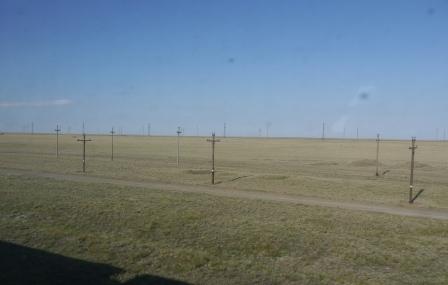
The view out of the window had remained largely unchanged from the previous evening. Largely flat as far as one could see, the hardiest of vegetation, grasses mostly, the odd scraggy bush, an occasional tree. Arid Steppe. Inhospitable. Just an unceasing line of telegraph poles alongside the track, each seeming to pass in time with the rhythmic motion of the train. Mesmorising.

Then occasional patches of green. Wispy grasses, like strands of fine hair, flowing in the gentle breeze. A few small houses dotted around. Cultivated plots surrounded by trees. The odd camel wandering around. First sighting along the Silk Roads.

A few stops offered the chance to step off the train and wander along the platform. Colourful stalls. Later on, closer to our destination Kyzylorda, women selling dried Aral Sea fish in the afternoon sun, a light breeze making it quite pleasant. Even the routine Police check onboard was, it turned out, uneventful. The officer appeared to have a look of consternation when inspecting our papers. But no, explained Alexander when he’d gone, it was just that all of us, the Policeman included, shared exactly the same day and month of birth.

Most of our fellow passengers seemed to be families, except for three carriages at the rear, between the coupées and the baggage car where I’d secured Emma. Young conscripts off to join the Army. Their families and girlfriends packed on to the platform the previous evening to wave them off. Much cheering and bravado. But now quiet, calm, as we meandered across the Steppe. Just the odd old lady wandering past, offering newspapers or a few other sundries.

Such serenity was in marked contrast to the previous day. By mid-morning I was beset by my first bout of traveller’s diarrhoea, dreading the thought of twenty four hours couped up in a train, camped in what I feared would be a very dubious toilet. I toyed with delaying my departure but quickly discovered there wouldn’t be another space for almost a week. And that would throw my plans for crossing Kazakhstan into turmoil. So, tonight’s train it would have to be.

In a series of brief forays from my lodgings, waiting for the medication to begin to, well… err stem the flow I suppose, I stocked up on a few essentials. Some more tablets to help make the journey bearable, plenty of water and lots of extra re-hydration salts. My phrase book didn’t really extend to dealing with such situations, so I’d had to rely on a bit of acting. Pleased I was the only customer in the pharmacy.

I’d allowed plenty of time to ride from my lodgings to the railway station, just in case of a puncture, or under the circumstances, the odd rapid detour down a side road. In the end, the journey passed without event, and I was able to board the sleeper quite early. But not as early as I thought. Quite convinced I’d been in the correct time zone in Atyrau, the train nevertheless departed an hour earlier than I’d expected. Bemused, I could only imagine that as Kazakhstan has two zones, perhaps, to avoid confusion, the timetables stuck with one. But not the one I was in.

[With thanks to the Oxford Handbook of Expedition and Wilderness Medicine and James at Travel Health Consultancy – www.travelhealthconsultancy.co.uk – for guidance on diagnosis and treatment, and my brother Steve for practical, reassuring advice]

Share

Dark days, lonely nights

May 29th, 2010


“I cried a lot, I was scared a lot and I wanted to quit most of the time”

Back in February, beyond Istanbul, there’d been dark days, lonely nights. I’d really struggled, endless tussles with myself. Was this really for me? There were glimmers of light, my stay in Alapli with Zehra and her friends, but the clouds soon returned. But why? True, the Black Sea escarpment had some serious climbs – maybe six thousand feet each day – but that was bearable, even if I felt a bit frustrated by such slow progress. I was confused. The small villages I passed through reminded me so much of Serbia and Bulgaria, countries I’d felt so enthused by. People were welcoming, friendly, often beckoning me off the road for sweet Turkish tea. It just didn’t make sense.

There’d been tough days before, but never the insidious self-doubt that was beginning to creep in. I found myself becoming increasingly pre-occupied with self-analysis, much of it far from helpful, trying to work out what was gnawing away at me. I’d always imagined, even expected, there’d be times when I might falter a bit, question what I was doing, and why. But not yet, not here. I’d gambled everything on this project, thrown my all into it. Failure, I told myself, simply wasn’t an option. Period. There’d been tough times in my life before, but I’d always persevere, never given up hope, never quit. And I wasn’t going to start now. I couldn’t – wouldn’t – let people down – family and friends, The Outward Bound Trust, people I’d met on the road who’d been so kind and generous.

It seems so obvious now, looking back, but that’s the beauty of what mathematicians call an elegant solution to a problem, its breathtaking simplicity. I lacked focus. I needed clarity, definition, but instead felt as if I was drifting. I’d been determined, driven even, to set off on my chosen departure date, to stop talking about it and just get on with it. Across Europe, following the Danube much of the way, momentum borne out of wanting to stay ahead of the winter further east. Mission complete. Asia had a fairly well defined route – across Turkey, Georgia, the ’Stans and China, down towards Australia – but – given I had a year to complete it to achieve the optimum weather window for Alaska – I was missing the time pressure I’d found so motivating across Europe.

Back then, when things seemed far less clear, I at least knew I needed to do something. But what? So I bought a small notebook, scribbling down thoughts, ideas, issues I needed to address, searching for The Plan. Slowly, ever so slowly, the mists began to part, a glimmer of light. Then the realisation, so obvious now, that I needed to generate the same focus and momentum I’d had for Europe. But how, and where? For a brief moment – a few days – I’d contemplated a return to the UK, albeit not my own cottage, but my brother had rightly counseled against that. More scribblings, scouring the maps, and I hit on Malta. An elegant solution it seemed, and it was. Take up the slack in the programme for Asia, sort out some niggling minor injury, and a few other issues before wilder times in the ’Stans and China. I had the makings of a plan, something to drive at. I’d met up with my Dad in Trabzon, eastern Turkey, and discussed my idea. We agreed it made sense. I had The Plan.

But I was still feeling unnerved by my bouts of self-doubt. Was this really normal, to be expected? And so soon? I’d met Al Humphreys a couple of times when I’d been researching my venture. He’d spent four years cycling around the world and had written a couple of books about his experiences. Honest, frank writing, beautifully crafted, enthralling even for those who aren’t cyclists. I’d remembered he’d been very open about the tough times – “I cried a lot, I was scared a lot and I wanted to quit most of the time” – there’d been many, he’d often felt like quitting, but he’d made it. So I asked my Dad to bring the books out to Turkey. I read them quickly. Reassuring.

[To find out more about Alastair Humphreys visit www.alastairhumphreys.com]

Share

Muddy waters

May 28th, 2010

“Life isn’t about waiting for the storm to pass. It’s about learning to dance in the rain”

Mud coats the streets after wet spells… ….bring appropriate footwear” advised my guidebook. They weren’t joking. Emma and I had relocated half a mile or so to cheaper lodgings, waiting for the train east from Atyrau. Looked like we’d been off-roading at Passchendaele.

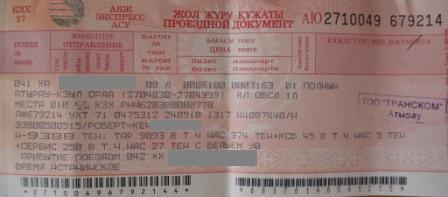
Sheltering indoors from relentless torrential rain, I’d spent a bit of time studying my rail ticket. Trying to decipher the Cyrillic text, with bit of help from my phrase book. Reckon I’ve berth 010 in carriage 08. Probably time for one last visit to my local hostelry, ’The Guns and Roses’. Don’t believe I’m in Kazakhstan? Then check out their website www.thegunsandroses.com. Feel free to leave a pint behind the bar for me in their Shymkent establishment. Should be there on Sunday evening.

[With thanks to Austin in Tbilisi, Georgia, for the opening quotation]

Share

Crossing Kazakhstan

May 27th, 2010

Less than three weeks to reach the Chinese border. Otherwise I’ll need a fresh visa. Problematic at best. Unfortunately, this means compromise is unavoidable. Cycling Kazakhstan in its entirety, a country sixty percent of the size of the European Union, simply isn’t a practical proposition. Ironically, I’ve a generous Kazakhstan visa that would allow me to do so. But then that would jeopardise China. Practicality over purity.

Quite apart from reaching the Chinese border in time, I’m determined to visit Bishkek, the Kyrgyz Republic’s Capital. Scene of rioting in recent months, the situation appears to have calmed a good deal, making safe entry feasible. Keen to track down our Honorary Consul at Fat Boy’s Cafe. And I’ve an offer of tea at the British Embassy in Almaty, until relatively recently Kazakhstan’s Capital. Shame to miss that. A few things to weave into the plan for crossing the country.

The plan? A train from Atyrau, at the northern end of the Caspian Sea, to Kzyl-Orda, about three hundred kilometres east of the Aral Sea. Across largely flat, featureless terrain. But not the easiest of options. A twenty four hour journey. I’d been advised to take the luxury option for about forty pounds – a twin berth sleeper. Curious to know who I’ll be sharing with. Hopefully Emma, my trusty steed. Might have to pay a bit extra for that. We’ll see. I’ll reach my destination close to midnight so could be interesting finding somewhere to sleep.

Rail ticket

Getting the rail ticket had been a bit tricky. Queued for quite a while, only to reach an impasse. I’d a piece of paper explaining, in Kazakh, exactly what I wanted. Couldn’t understand the problem. Lots of phone calls made by the saleswoman, but no, a ticket wasn’t possible. Frustrating.

A young man, next in line, explained that the difficulty was that my name needed to be translated into Russian Cyrillic to be entered into the booking system. No doubt he could have done it for me in seconds, but he’d been pacing around endlessly, trying to push in front of me, so helping out now wasn’t going to happen. Instead, I disappeared off to seek further help from English speaking Manshuk in a local hotel. Half an hour later I had my ticket.

Beyond Kyzl-Orda I’ll be heading south-east for about four hundred kilometres to Shymkent, swinging north-east through the mountains towards the Kyrgyz Republic’s border. Brief foray into the Capital Bishkek, then back into Kazakhstan and its former Capital Almaty. Few days there and then the push through the mountains to the Chinese border. Fingers crossed.

Share

Arrival in Atyrau

May 26th, 2010

We’d final made it. Kazakhstan. Atyrau in the west, at the north end of the Caspian Sea. A few formalities, another X-ray for Emma, and we were in. I’d really been looking forward to this, ever since securing my visa back in Tbilisi, Georgia. Friendly, helpful Consular staff. First impressions do count.

Emerging from the small terminal building, I met Dave, a New Zealander and engineer in the local oil industry. And fellow cyclist. I’d spotted his western mountain bike and hailed him. He led the way towards Atyrau for a while before heading off across country. Cross the Ural river that divides the small city, Dave explained, and you’d be back in Asia. A brief foray back into Europe over, just a few kilometres.

Oil is big business here, yet Atyrau seems to have avoided the worst excesses of Baku, no exorbitant prices. Not that they don’t cater for a sizeable ex pat community or visiting petroleum executives. There is the odd five star hotel. And a few bars and eateries with a familiar Western feel. But with prices comparable to those you’d find in the UK. Bit tough on my own budget, but fair.

It’s early days here, but one thing is already very clear about Kazakhstan. Bears no resemblance to the country portrayed, much to the rightful consternation of its people, in a certain film a few years ago. But that’s probably because it was shot in Romania. Where, incidentally, the people also don’t look anything like the Kazakhs. Right, time to nip down to the local ’Guns and Roses’ pub for British beer and some familiar bar food. Satisfying my curiosity about the ex pat world here.

Share

Reflections on Azerbaijan

May 25th, 2010

“…one does not have to believe everything is true, one only has to believe it is necessary…” Franz Kafka (’The Trial’)

Corruption distorts, undermines any sense of fair play, the Rule of Law. And in a society where it’s part of the very fabric of everyday life, the consequences can be quite perverse. Embezzlement for example. You’d be forgiven for thinking going to the Police, placing your trust in the Judiciary, would be pointless. The perpetrators could simply pay off the right people, the case against them petering out. But, I learnt, you’d be wrong. Threatening to call in the Police is a powerful lever. Not because they’d be likely to arrest anyone, let alone charge them. No, because they’d demand a significant cut of the stolen funds. Justice of sorts?

Azerbaijan, it is widely acknowledged, is a very corrupt nation. And with little incentive to change. No lack of foreign investment. You might wonder why anyone would wish to invest in a country where much of your profit is likely to be skimmed off? Unless of course earnings are vast, illicit payments lost amongst them. As might be the case, say, if you had huge oil revenues. Which Azerbaijan does. The price of doing business? Not that I believe that respectable foreign companies are actually complicit in dubious or illegal practices – no one wants to loose profits, it’s just unavoidable.

What helps perpetuate corruption is, for all the mobile phones and Mercedes, the almost feudal structure of sections of society. Payments are often collected not for the pockets of those extorting them, but for their masters. If they wish to keep their job. You sense ordinary people just accept that this is how it is, shoulders shrugged, resigned to it. Most have food on the table. And they want to keep it that way. Of course, not everyone is corrupt, far from it. Problem is working out who to trust.

Family ties are an important part of life here. Nepotism? Not unique to Azeri society, I’d venture even in the UK connections can play a part in getting a job, or at least a foot in the door. But merit still counts for a lot. Not so sure here. Want a decent job? Try hard cash as well. For the employer. Not you. I’d met a graduate still doing bar work after five years, unable to buy into a job, lacking the family connections. Should you be concerned? If you live here, certainly. Imagine the unfortunate situation of, say, ending up in hospital, having to go under the knife. Picture yourself on the trolley, on your way to the operating theatre. Pondering just how the surgeon got the job. You’d be hoping it was on merit.

I’ve also sensed a lethargy amongst the older Soviet generation. Familiar with a time when the State gave you somewhere to live, a job for life. Whether you actually did anything or not really made little or no difference. Not corruption, more a bar to progress. I’d learnt of an architect who spent twenty years knitting. Mind you, quite understand not wanting to put your name to any of the hideous concrete structures that sprang up under Communism.

But what are my own experiences of corruption here? Lots of anecdotal evidence, reliable sources, but directly? A little. Surprised? No. I’m not in business here, a foreigner, a visitor to the country, passing through. The odd unexpected fee to pay. Volunteered of course, so I suppose that makes it just semi-consensual theft. Oh yes, and I haven’t driven here. Standards on the road pretty reasonable, for the most part. But seems ex-pats not so good. Get stopped an awful lot by the traffic police.

For the most part, I’ve just had to put up with incessant efforts at over-charging or vastly inflated prices. Admittedly largely confined to the centre of the Capital, Baku. I’ve seen filter coffee for about ten pounds. Corruption? No, more a distortion, people eager to exploit those they perceive to be wealthy – Western Europeans amongst others – encouraged by a good many willing to pay far over the odds for things. Some would say it’s just good business.

But for all the societal problems, ordinary people, especially in the towns and villages, in roadside cafes, have been incredibly friendly, at times with an almost a child-like innocence, inquisitive. Many individual acts of generosity, the extent unimaginable in supposedly more developed nations. Much of it against the backdrop of the Greater Caucasus Range, its snow capped peaks contrasting with the sun baked wide valley flood plains below. Would I return? Of course. A fascinating country, warm and welcoming, albeit with a society so markedly different to my own. Intriguing.

[Author’s note: This post is dedicated to Carol, fellow traveller in Tbilisi, Georgia, regrettably unable to visit Azerbaijan herself. Various independent sources rate Azerbaijan as a very corrupt nation, but they’re far from the top spot. Presumably to secure that they’d need to pay a small fee…. But, most of all, thanks to those individuals, understandably wishing to remain anonymous, who’ve been very candid about their experiences of life here]


Share

Playing the game

May 24th, 2010

Taking a bicycle and all your kit on an aeroplane is, at best, not the simplest of evolutions, the risk of damage ever present. And potentially quite expensive. But imagine two scenarios. At one airport that’ll be two hundred dollars for excess baggage, take it or leave it, and pot luck as to how much your bike gets thrown around by the ground handlers. And lots of pointless carriage requirements, such as having to deflate your tyres. Or remove the pedals.

At another airport, Emma is carried out to the aircraft, intact, placed in the hold, other luggage carefully packed around her. Ground crew so proud of their efforts to protect her, they insist on showing you their efforts before you board the aircraft. Even if it’s an ageing Russian built jet that looks like it belongs in a museum. And the excess baggage – most of the panniers and the bike itself – well, always scope for negotiation. Cash helps.

The first scenario could be many a First World airport. But the second? Baku’s international airport. So, it would seem, Azerbaijan is, quite unexpectedly, actually a pretty good place to fly out of with a bike. Of course, I’d been in the city for a while and had learnt something of how things work. Knew how to play the game. Like a firm and generous handshake. Mind you, still had to put the entire bicycle through the X-ray scanners. Three times. No way around that piece of fun.

[Author’s note: If you are planning to follow in my footsteps and fly with a bike from Baku to Kazakhstan, I’d be delighted to share more details – hints and tips – with you. Contact me via the website]

Share

Rules of the game

May 23rd, 2010

A short postscript to the recent Baku armchair adventure…

So. You’ve reached Baku and want to catch the ferry across the Caspian to Aktau in Kazakhstan. Even if you haven’t, and have no plans to do so anytime soon, you may nevertheless find the story below intriguing. If only for the insight it provides into life in Azerbaijan…

Firstly, get yourself a local SIM card for your phone. Absolutely essential. Unless you want to die of old age here. Or be deported for overstaying your visa. Truth is, and that can be a very elusive quantity around here, in either case you’ll go bankrupt first. If, like me, you no longer have a mobile, you can acquire the complete package for around twenty pounds. Go and chat to the very helpful, trustworthy staff in Baku’s Tourism Information Center. Good English to boot.

Next, visit the port and locate the ticket office. Expect a door with ’Kasse’ painted on it, nothing more. From very close – fifty metres – to the intersection of Y.Safarov Street and Nobel Avenue, head down a rough road for a couple of hundred metres, past various wrecks of buses. Some may still be in service. Find the lady who seems to be there during the week, give her your phone number, and a small fee to help with the usual administrative costs. This last bit is crucial. Otherwise see previous paragraph. Crisp US dollars work best.

Then wait. By all means take the number of the ticket office, and call them twice daily, around ten and three. Great if you speak Russian or Azeri, but just saying ’Ship Kazakhstan’ works fine, with the usual pleasantries. If you do need help with the language barrier, the Tourism Information Center can help out. You suspect they have the ticket office on speed dial.

Now the intriguing bit. You’d be forgiven for thinking that ships to Kazakhstan are pretty rare, a few times a month. No schedule, they just go when there’s sufficient cargo, often at just a few hours notice. Admittedly things may be a bit different in winter, but otherwise there seems to be rather more sailings than you’d be led to believe. I reckon there’s one every 3-4 days, weekly at worst. Maybe it’s just coincidence, but, until I’d made a small cash donation towards administrative costs, the ferries were just rumours, ghost ships. Contribution made, phone call the next day. Ship to Kazakhstan.

[Author’s note: Oddly enough, the Kazakhstan end of the operation seems to have a far better grasp of what the ferry is up to – call agents Tagu in Aktau on 3292-513989.

Self-imposed editorial rules prevent identification of the lady at the ticket office, or the size of the contribution made to cover administrative costs. However, if you are planning on catching a ferry to Kazakhstan, contact me via the website – if I’m satisfied you’re a genuine traveller I’ll normally share this information with you]

Share

On the couch

May 22nd, 2010

Many things in Azerbaijan had seemed strange, so suppose this wasn’t any different. I’d been staying in Baku with Brian and his daughter Savannah, expecting to sleep on the couch. But no, I’d had the master bedroom. En suite. With a sunken bath.

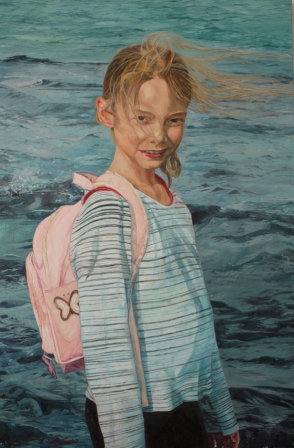
Savannah

An art teacher at one of the International Schools, oils were Brian’s medium. Bright, colourful paintings. Of course, being Azerbaijan, taking them out of the country required payment of a hefty fee to have them certified as not being a national treasure. Even if one was so obviously his daughter. And his signature was on the canvas. Not like you were trundling off with the Elgin Marbles in a wheelbarrow.

They’d lived in Mongolia. Surviving largely on tinned food and sheep fat, heading out in the winter in temperatures of minus thirty-five. Too cold for snow outside, inside in the stairwell the air warm and damp enough to produce a light dusting of the white stuff. Their time spent in China sounded much more appealing, fascinating anecdotes, useful insight into what I might find when I get there.

There’d be ample opportunity to discuss many issues at length. Favourite amongst them was the classification of countries. First World. Second World. Third World. Developed. Developing. Surely every nation was still developing? The British Empire used to be readily identifiable as the pink bits on a map. But what of those countries that were largely nondescript, for whom existing monikers didn’t really fit? Like Azerbaijan, suggested Brian. They were beige. Not bold, like red or black. Not especially better than any other country, nor especially worse. Neutral. Not to be meddled with, no matter how well-intentioned. They’d need to be left alone to find their own place in the world. Help offered perhaps, never imposed.

Brian and Savannah been very understanding of my own trials and tribulations, my attempts to board a ship to Kazakhstan, thwarted, it seemed, at almost every turn. And my efforts at preparing dinner. It wasn’t the food as such, more my dismantling of one of the kitchen units to unstick a drawer. Sometimes it’s best not to see what the chef’s up to.

[The author is hugely indebted to Brian and Savannah for being such generous and understanding hosts. And for quite a while. Original painting copyright Brian Hawkeswood. Image reproduced above with kind permission of the artist]

Share
Terms & Conditions of Use | Copyright © 2009-2026 Ken Roberts